Actions, not only answers
Agents that create, file and book in your systems, through tools written for your business.
An AI agent reads a request and carries out the next step in your systems through a fixed set of tools: a WhatsApp message becomes a booking, an invoice reaches your accountant, a promising lead gets a call in your calendar. Pluton Studio builds AI agents in Prishtina for businesses in Kosovo, Albania and the diaspora, and a person approves anything that involves money.
An AI agent is software built on a language model that takes actions in your systems through a fixed set of tools, such as creating a booking, filing a document or updating a customer record.
A chatbot answers. An agent answers and then does the work that follows: it reads the request, picks the right tool, fills in the data and, wherever it matters, hands the result to a person to approve. If answers are all you need, a chatbot is the simpler and cheaper choice, and AI agent or chatbot shows where the line sits.
The tools are narrow actions we write for your business, for example: look up a customer, create a draft booking, attach a document to a job. The agent can use those and nothing else. Agents are one part of our AI and automation work.
Five kinds of work where an agent earns its place. Each example shows what the agent does and what stays with a person.
| Job | Example | What stays with a person |
|---|---|---|
| A message becomes a job or a booking | A customer in Germany writes on WhatsApp, half in Albanian and half in German, asking for a car from 12 to 26 July. The agent reads the dates and the car class, checks availability and prepares the booking. | Confirming the booking and the deposit |
| Documents read and sent to accounting | Supplier invoices arrive by email. The agent reads the supplier, date, amounts and items, matches them to the order and prepares the entry for your accountant, flagging anything that does not match. | Approving the entry and every payment |
| Leads qualified and booked | An enquiry arrives from your site or Instagram. The agent asks the two or three questions you always ask, checks the answers against your rules and books a call in your calendar. | The sales conversation itself |
| Answers from your own records, with the source | Someone on your staff asks what was quoted to a client last spring. The agent answers from your records and shows the record it used; if the answer is not in the data, it says so. | Deciding what to do with the answer |
| A dispatcher's assistant | For a business with crews or vans, the agent proposes tomorrow's plan from open jobs, addresses and who is available, then waits. | Approving or changing the plan before anyone is notified |
An agent that can act can also act wrongly, so the limits are part of the build, not an add-on. Every agent we deliver has these five:
Your data and the accounts the agent runs on are in your name. The agent sees only what its tools return, never your whole database.
The language model runs at a provider named in the contract, so you know where every request goes. On the Swiss platform described below, for example, the model runs at a provider in the United States, and the offer says so in writing.
The application and its data can be hosted in Europe where you need it. If the model itself must also run in Europe, we set that up and quote it separately. Where we process personal data for clients in the EU or Switzerland, a processor agreement under Art. 28 GDPR applies, and what it contains is published.
For a field-service company in Switzerland we built a complete operations platform with seven AI features. One rule governs all of them: the model proposes, deterministic code decides. The model never computes money, never writes to the database and never renders a layout, and a person accepts each proposal with one tap.
Two of those features do jobs from the table above. A pasted email or WhatsApp message fills in the job form, the customer is matched by code on phone number, email and name, and nothing is created until someone saves. An assistant answers questions about jobs, equipment and money from the real records, attaches the records it found, and says so when something is not in the data. Rough notes become billable lines from the company's own catalogue: the model cannot invent a price, only pick one. Every feature has a deterministic fallback, so a basement with no signal breaks nothing.
The assistant in this site's header, Pluton AI, follows the same rule at a smaller scale. It answers questions about our services, prices and how a project starts, in Albanian, English or German. The model only writes text: code lifts every link out of its reply and turns only addresses that really exist, our own pages and our clients' live sites, into buttons, while an address the model makes up is dropped. The WhatsApp and call buttons are added by code when a visitor asks about price, timing or getting started, messages that try to rewrite its instructions get a fixed reply without reaching the model, and every question and answer is logged.
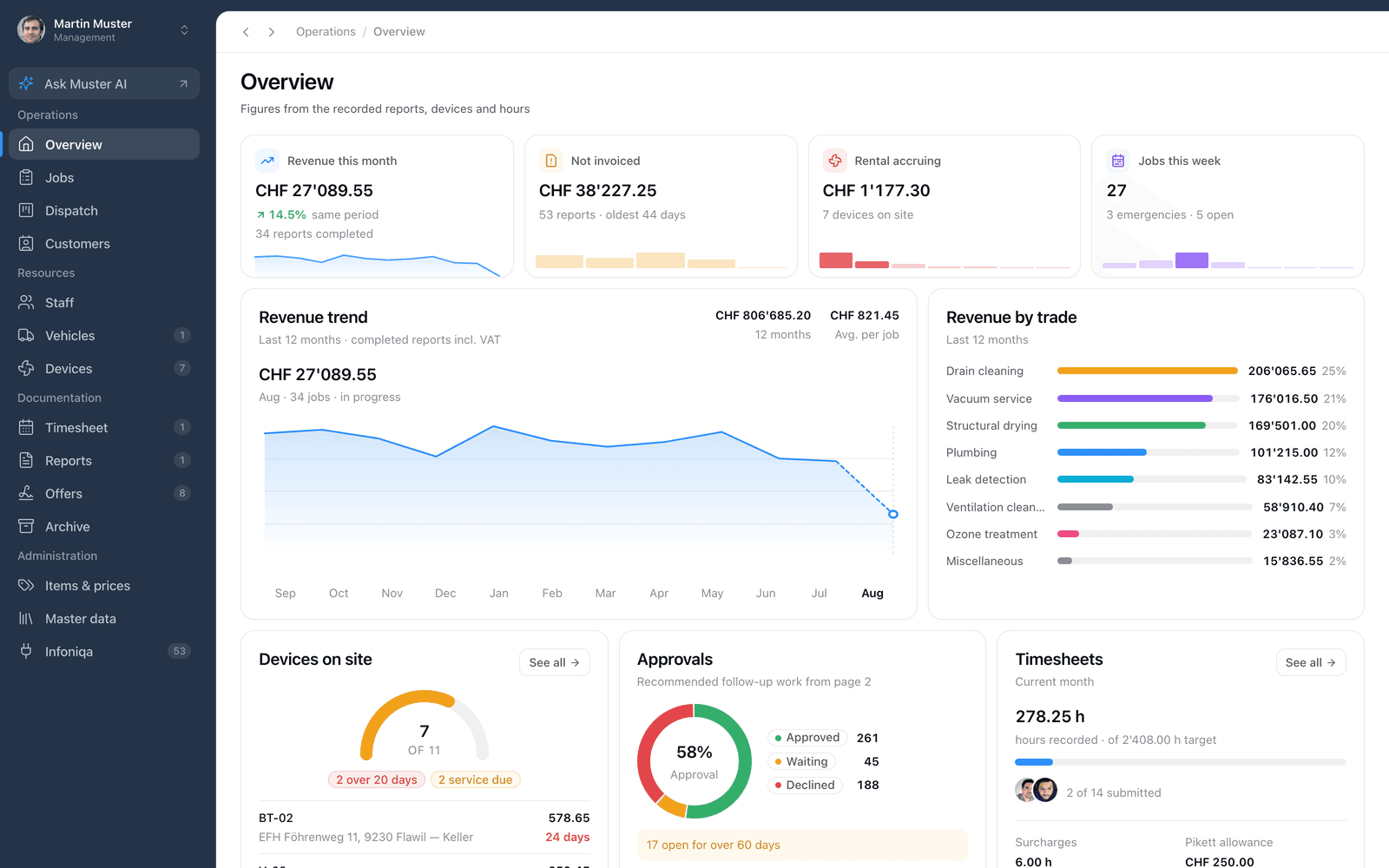
Operations platform for a Swiss service company: dispatch, iPad job reports, equipment rental, timesheets, German documents and an AI layer that proposes and never decides.
Pluton Studio is a software studio in Prishtina, Kosovo, founded in 2018 by software engineer Adrian Fusha. You work directly with the engineer who builds your agent, from the first call to go-live:
A first AI agent on one process starts at 1,500 euros. More processes, systems and languages are itemised in the quote.
Running costs for the language model are separate. They depend on how many messages or documents the agent handles, and the quote estimates them per month. Larger AI systems, with several agents across several systems, are quoted after a call.
If the work always follows the same fixed steps, process automation is often enough and simpler to run. How an agent's price is built, and how to estimate the model's running costs yourself, is in what an AI agent costs.
Agents that create, file and book in your systems, through tools written for your business.
Money and anything irreversible wait for a person, and every action is logged.
You work with the engineer who builds your agent, from the first call to go-live.
These are not marketing lines. They are the terms that go into every quote we send, so you know exactly what you get and when.
Every message is answered by the engineer who will build the project, not by a salesperson. The fixed written quote follows within two working days of the first call.
The quote lists everything included, and the price you sign is the price you pay. Scope changes are quoted separately, before they happen.
Business website: 3 to 5 weeks. Online store: 5 to 8 weeks. Web app or custom software: a first working version within 4 to 6 weeks, the rest on a written plan.
You see and approve the design on screen before a line of code is written. Two rounds of design revisions are included, and so are small content changes such as text, photos and prices for 30 days after launch.
Half at the start, half at go-live. Projects above three thousand euros are split into three milestones tied to deliverables, never paid in full up front.
Domain, accounts and content are registered in your name from day one, and the content exports whenever you want. No mandatory subscription.
Any defect found within 30 days of launch is fixed at no cost. The site ships inside the performance budget written into the quote, with a Core Web Vitals report on your own domain and a lab test you can repeat yourself.
An AI agent is software built on a language model that takes actions in your systems through a fixed set of tools, such as creating a booking or filing an invoice. It works on requests that arrive by email, chat or as documents, and a person approves the steps that matter.
A chatbot answers questions in a conversation. An AI agent also acts: it writes into your booking system, accounting or customer records through tools we define. The full comparison is in AI agent or chatbot.
A first agent on one process starts at 1,500 euros. More processes, systems and languages are itemised in the quote, and the model's monthly running costs are estimated up front. See what an AI agent costs.
You get a fixed written quote within two working days of the first call. A first working agent on one process follows in 2 to 4 weeks, and further processes are added one at a time.
Safety is built in, not added later. The agent can use only the tools on its allow-list and sees only what those tools return. Anything involving money or anything irreversible waits for a person, every action is logged, your data stays in accounts in your name, and the model provider is named in the contract.
Albanian, English and German, including the mixed messages diaspora customers write. Before go-live we test the agent on real messages in each language it will handle.
Usually, yes: email, WhatsApp Business, calendars, booking systems, accounting software and databases, through the connections they offer (APIs) or through exports. If a system offers no way in, we say so in the first call rather than after you have paid. When the agent needs a larger system around it, see custom software development.
Tell us a little about your idea or business and we'll reply with a plan and a quote, no obligation.