The overview
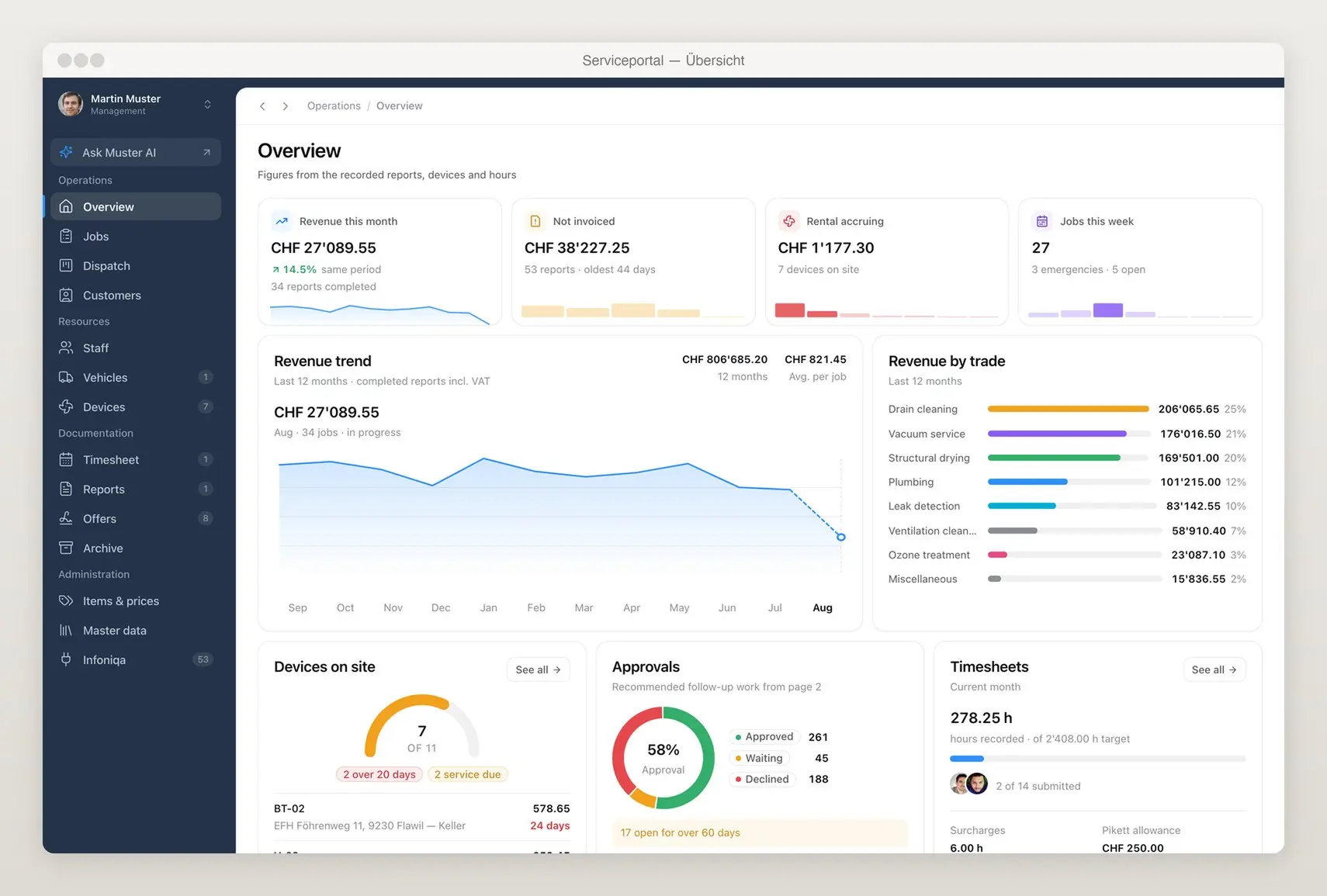
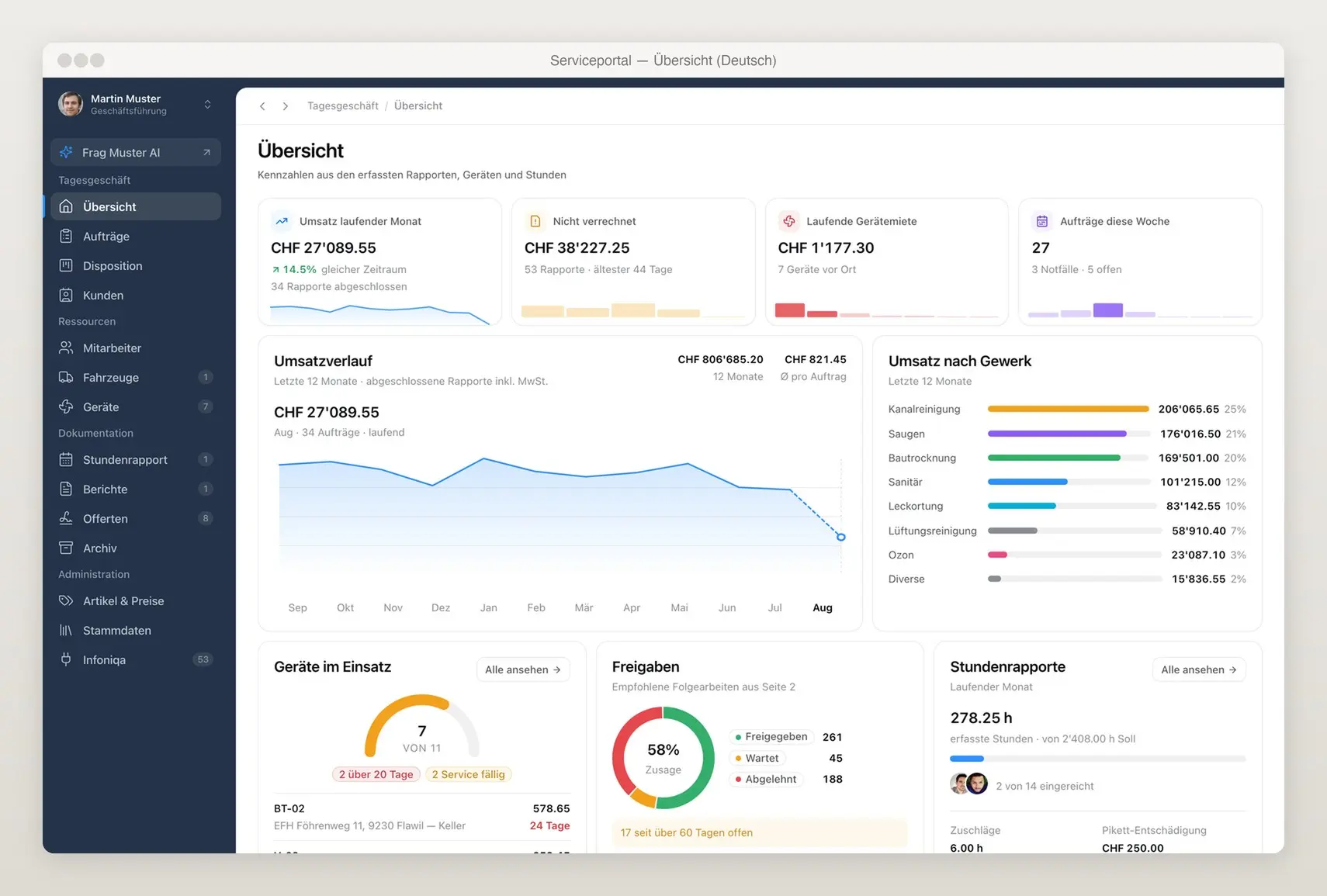
Revenue, unbilled rapports, running equipment rental and the week at a glance, all computed from the filed rapports. Shown with demo data.
Pluton Studio built a dispatch and job-report platform for a Swiss field-service company. It replaces folders, paper job reports (rapports, as the Swiss call them) and around fourteen PDF templates with one system, from dispatch to the accounting handover. An AI layer proposes and never decides alone.
In short
The platform has six modules: dispatch, iPad job reports, equipment and rental, timesheets, documents and quotes, and the accounting export. Seven AI features make proposals, and only what a person accepts goes through. The interface runs in German, English and Albanian; printed and emailed documents are always German.
The company runs emergency and service work around the clock: drain and sewer cleaning, plumbing, leak detection, structural drying, odour treatment. It has fourteen staff at six branches and six vans on the road.
The business ran on paper and a file share: a network drive with status folders that a job was dragged through by hand, and around fourteen fillable PDF rapports, each with its own embedded price list. Fitters filled the rapport in by pen, photos arrived over WhatsApp, and hours went on a monthly paper sheet.
Reports were already being written with an AI chat: the owner typed a few lines and had the text drafted. The writing was fine, the layout broke: the logo dropped out, the branch page vanished. That experience set the architecture.
Revenue, unbilled rapports, running equipment rental and the week at a glance, all computed from the filed rapports. Shown with demo data.
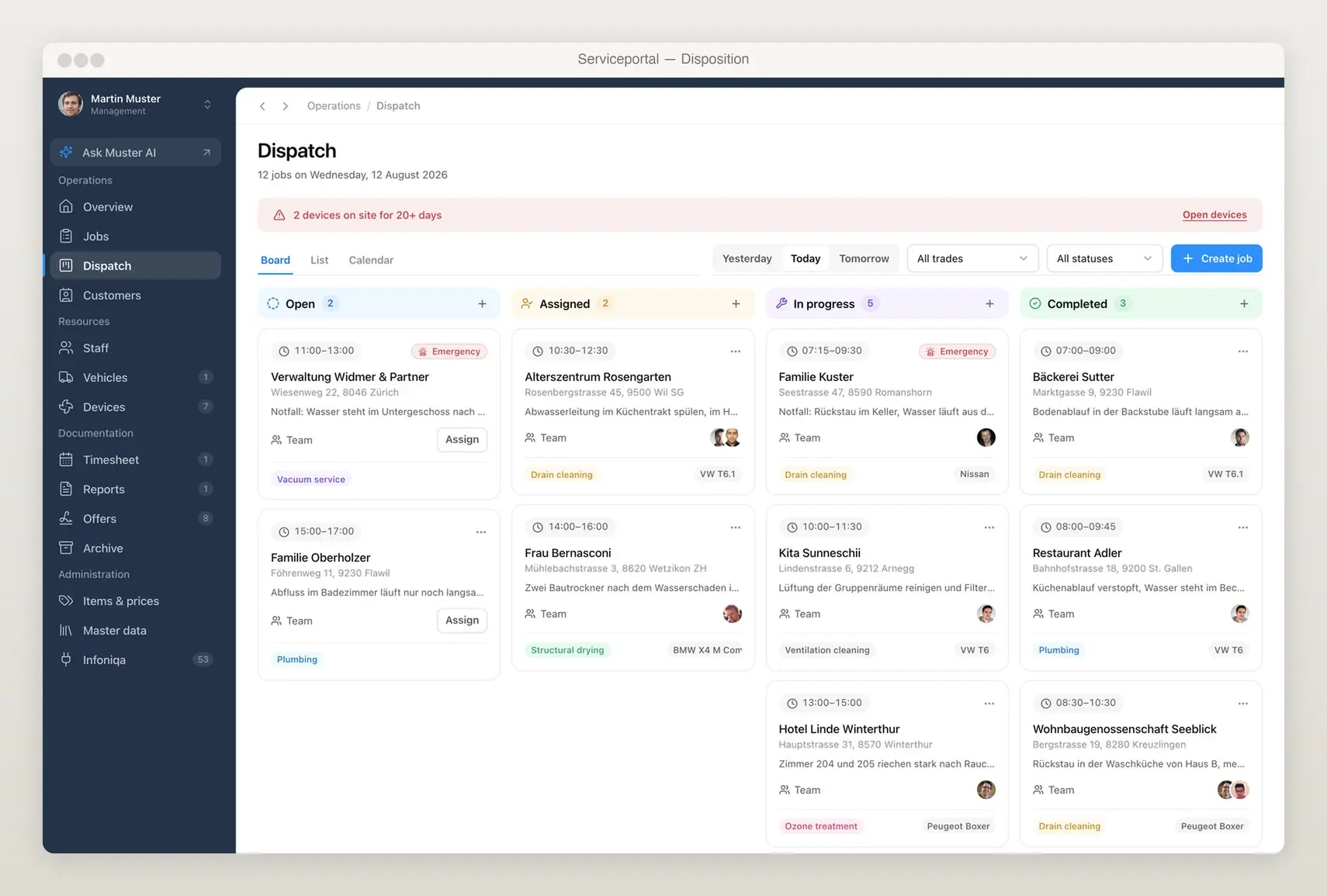
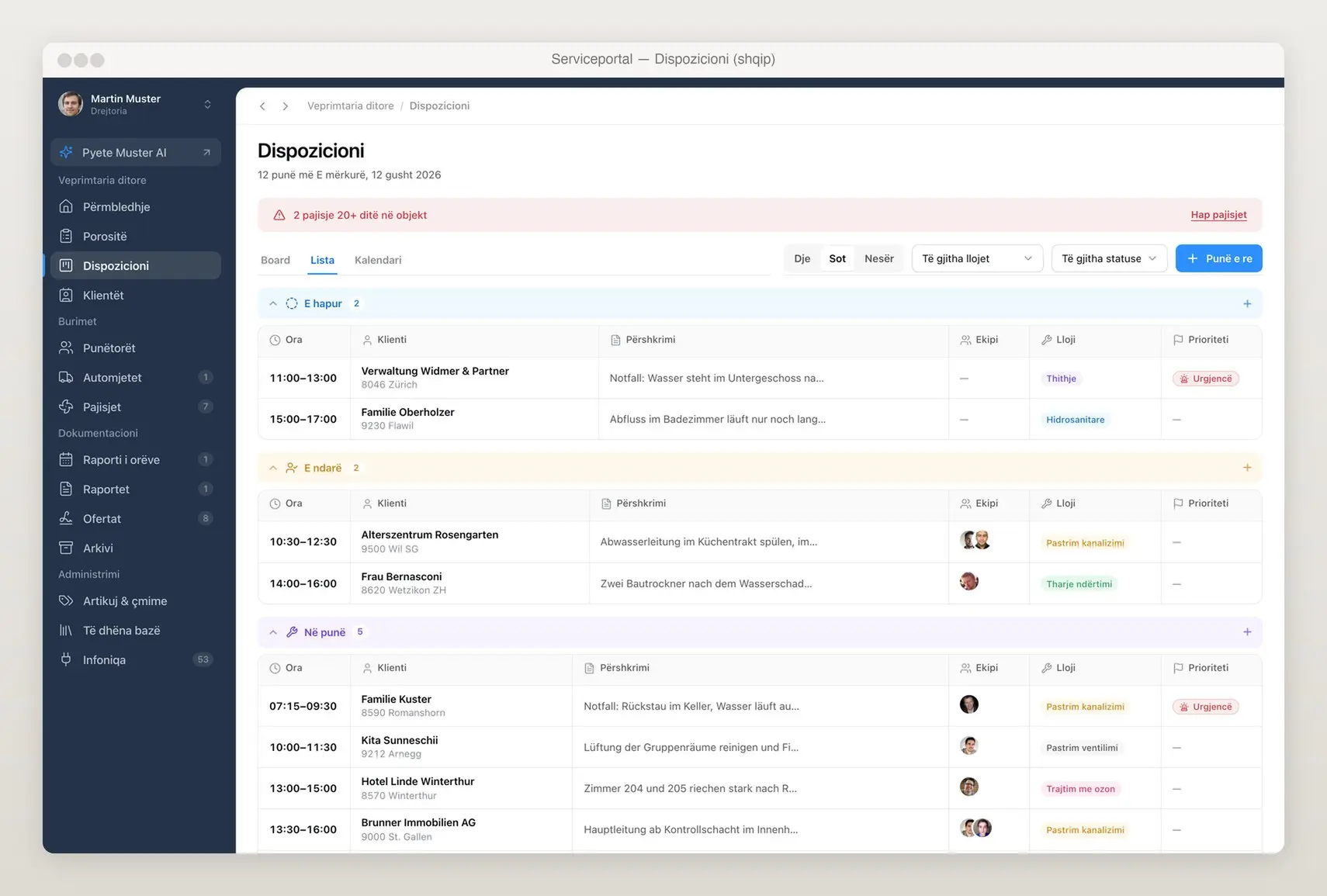
The day by status, with the vehicle and crew on every job. The folder tree on the network drive became one column.
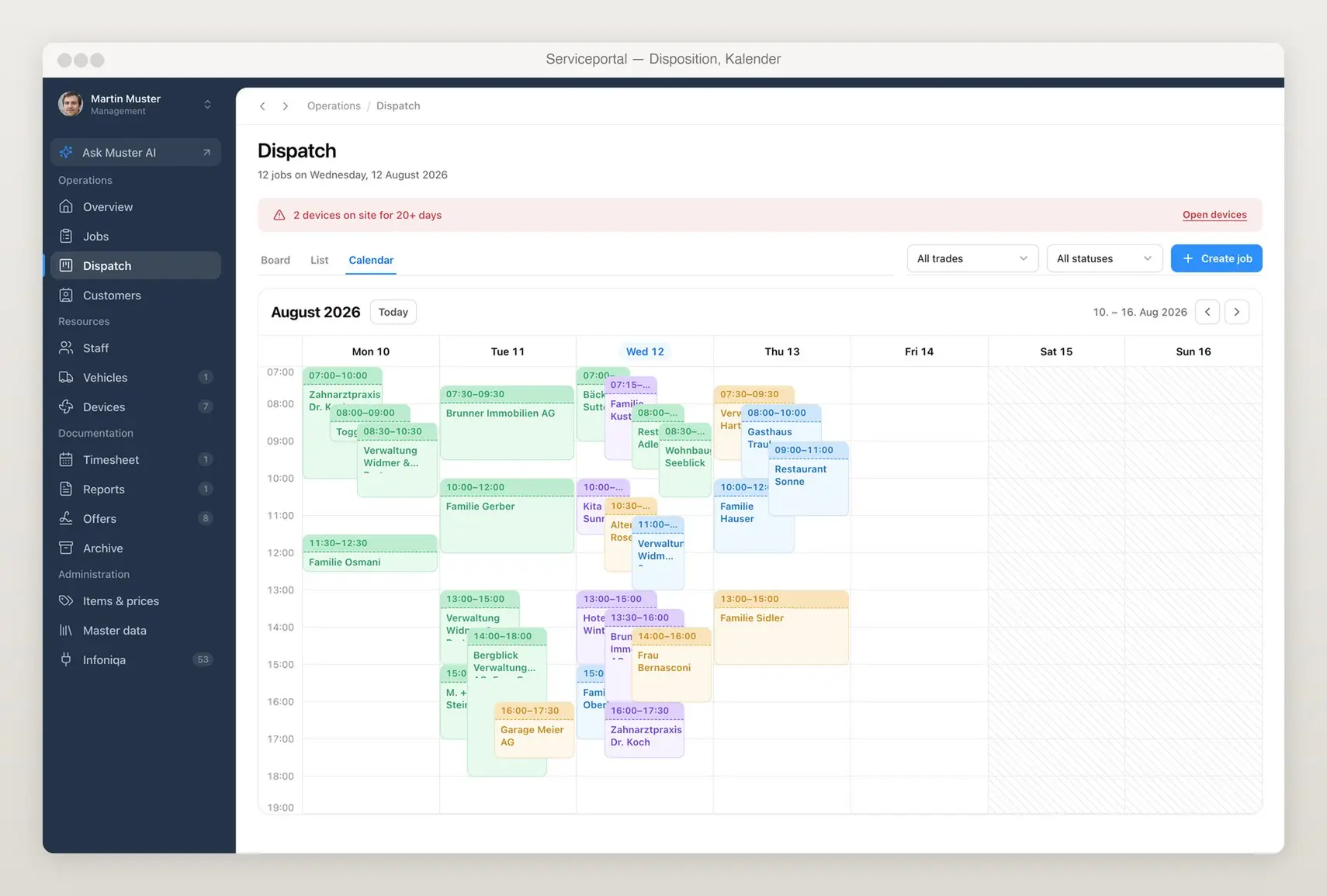
The same jobs as a week calendar, when the question is capacity rather than status. Clicking an appointment opens the job.
The platform is one web application with four access levels: management, office, vehicle iPad and employee. The vehicle iPad sees its day, never wages.
The six modules came out of the company's real documents: its position codes, rental rules, rounding, 8.1% VAT and its two separate surcharge systems.
| Module | What it replaces | Core |
|---|---|---|
| Dispatch | Folder tree, phone notes | Day board by status, vehicle and crew assignment, emergency flagging |
| Field rapports | Fourteen PDF templates | Checklists, lines from the catalogue, photos, signature on glass, live totals |
| Equipment | Nothing. This did not exist | Device registry, deployments, daily rental, kWh meter readings, service reminders |
| Timesheets | A monthly paper sheet | Breaks, night, Sunday and standby surcharges, office approval |
| Documents and quotes | Copy-paste from an AI chat | Rapport, report, quote, insurance dossier: layout in code, prose from the model |
| Accounting handover | Retyping | Invoice, customer and hours exports as a file batch |
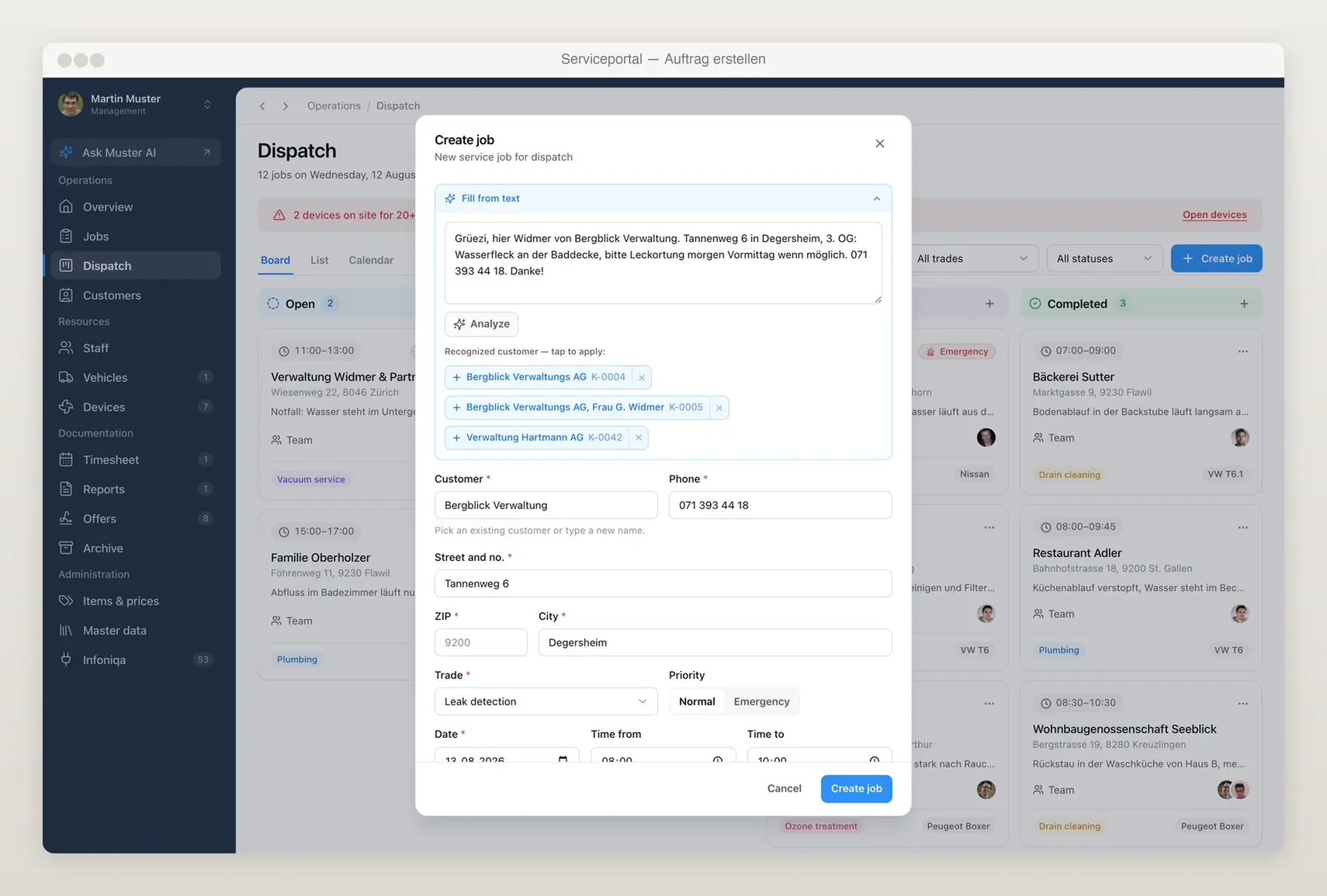
A pasted WhatsApp or email fills the job form and the matched customer appears as a suggestion. Nothing is created until someone saves.
Rough keywords from the field become rapport lines at the prices in the company's own catalogue.
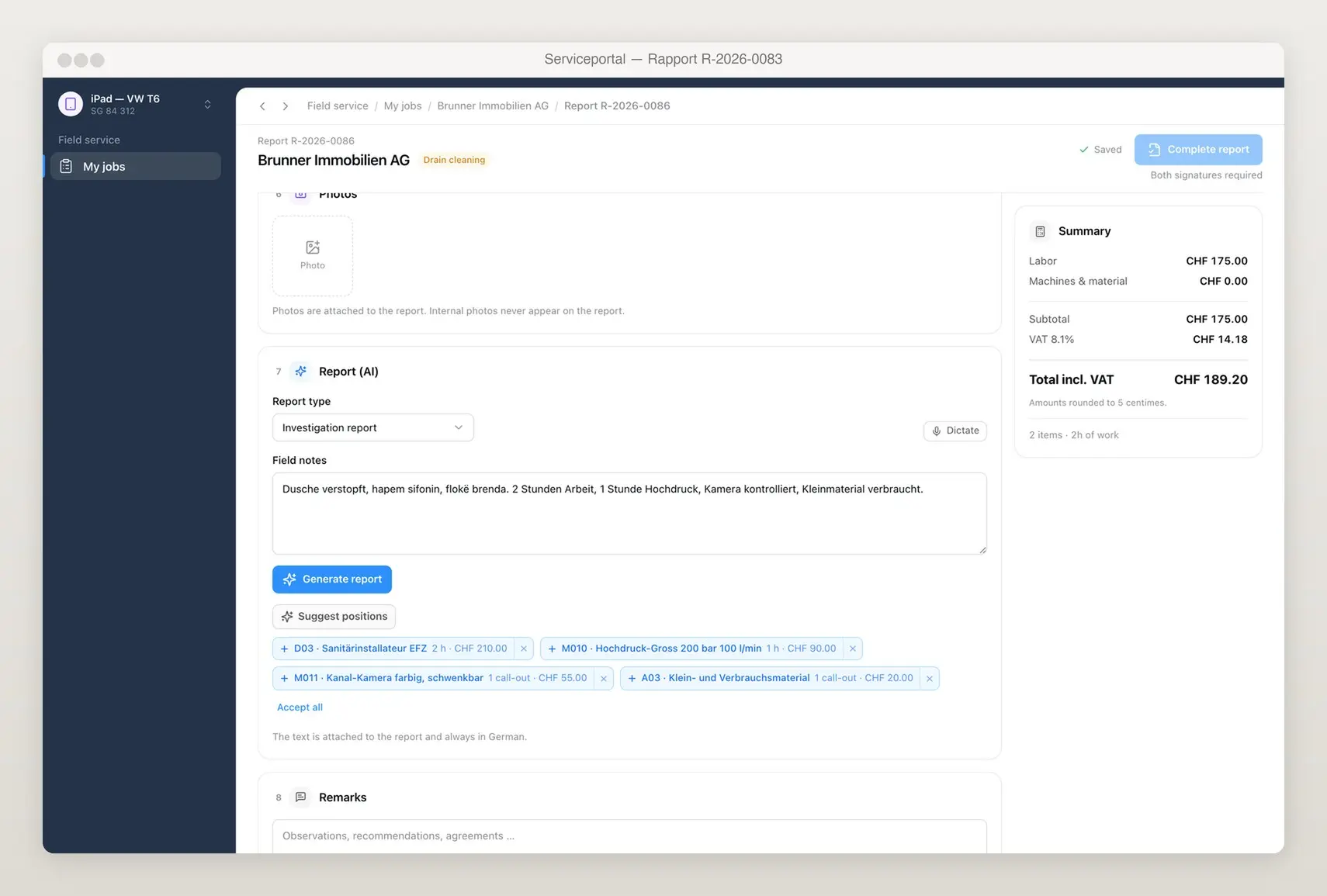
One rule governs every AI feature: the model proposes, deterministic code decides. The model never computes money, never writes to the database and never renders a layout: the letterhead, the branches, page numbers and every total live in code. A person accepts each proposal with one tap.
How we build AI agents for other businesses is on AI agent development.
The answer comes with the jobs it found, attached as tappable cards.
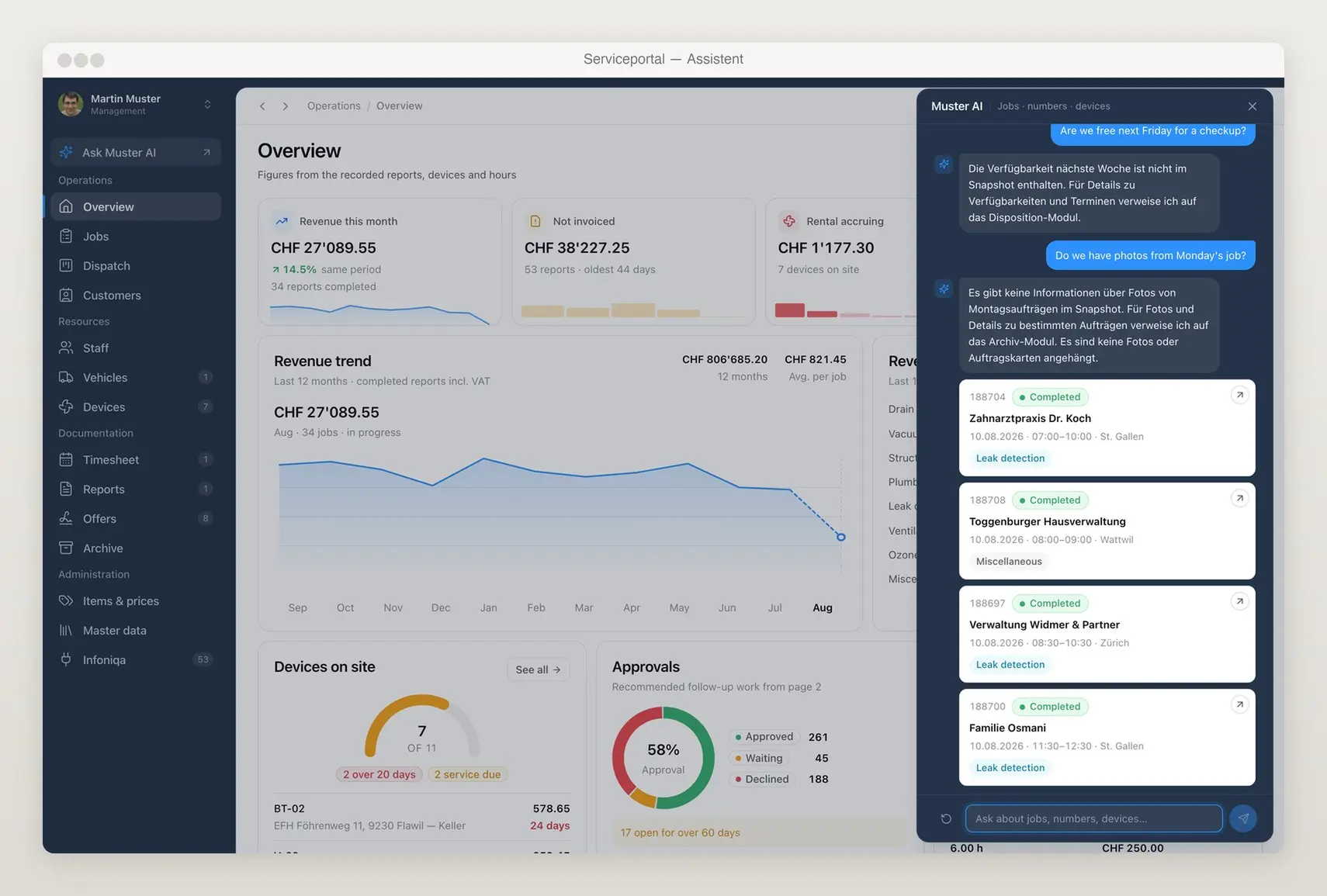
Some rules nobody states out loud, because inside the business they are obvious. The system knows them:
| Rule | How it works |
|---|---|
| Equipment rental | A surcharge for short rentals and a discount for long ones, computed by the day |
| Power consumption | Meter readings at install and pickup; unmetered devices billed at a flat rate per day per unit |
| Two surcharge systems | Customer surcharges for night and weekend kept separate from the wage surcharges the worker earns |
| Rapport page 2 | Recommendations carry a traffic-light state: proposed, approved, declined. Approved becomes a quote, accepted becomes the next job |
| Photo visibility | Every photo is customer-visible or internal. Internal photos never appear in a printed document |
| Price control | Every rate, rental rule and surcharge is editable inside the app. No developer needed |
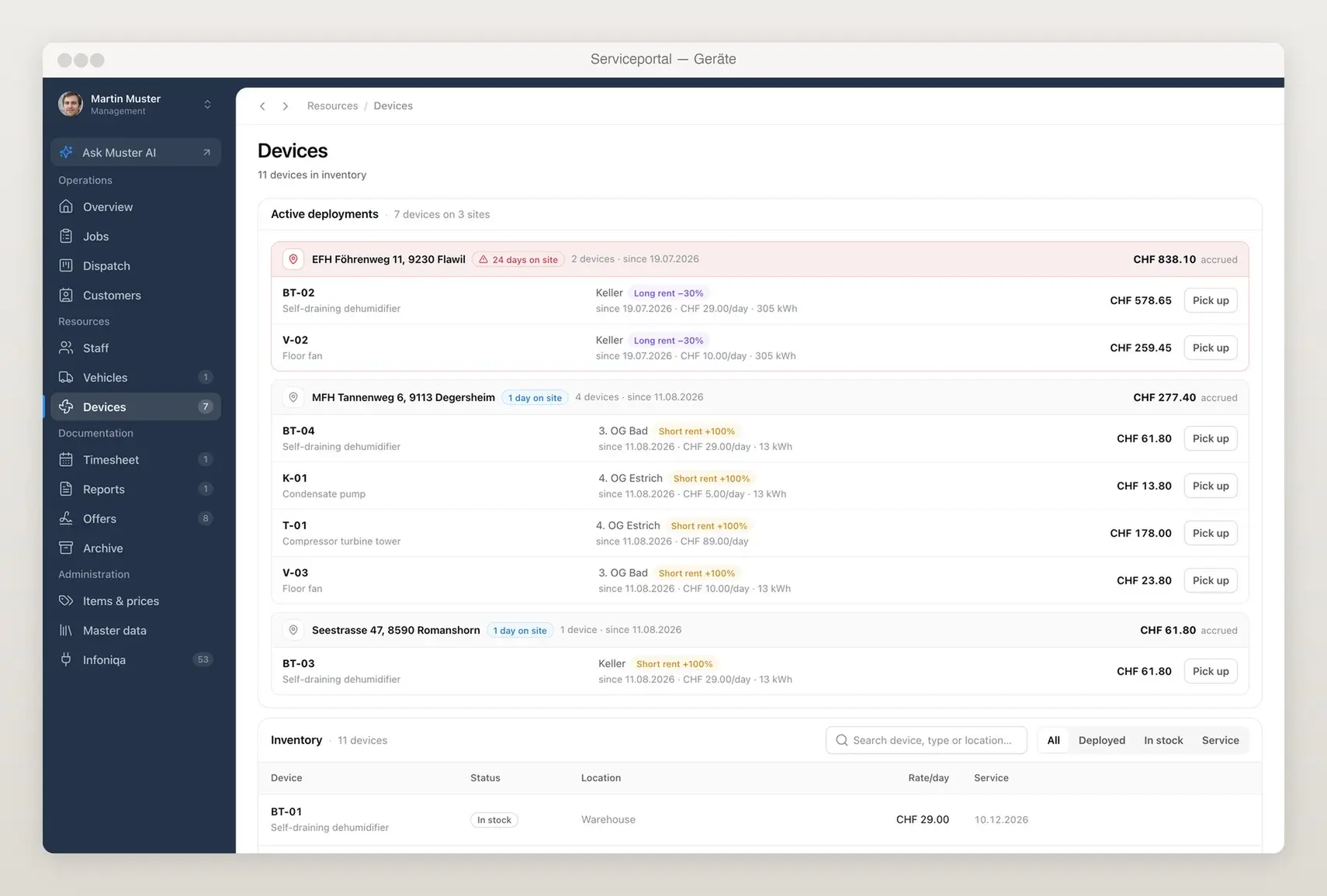
Where every dryer stands, for how many days and how much rent it has accrued.
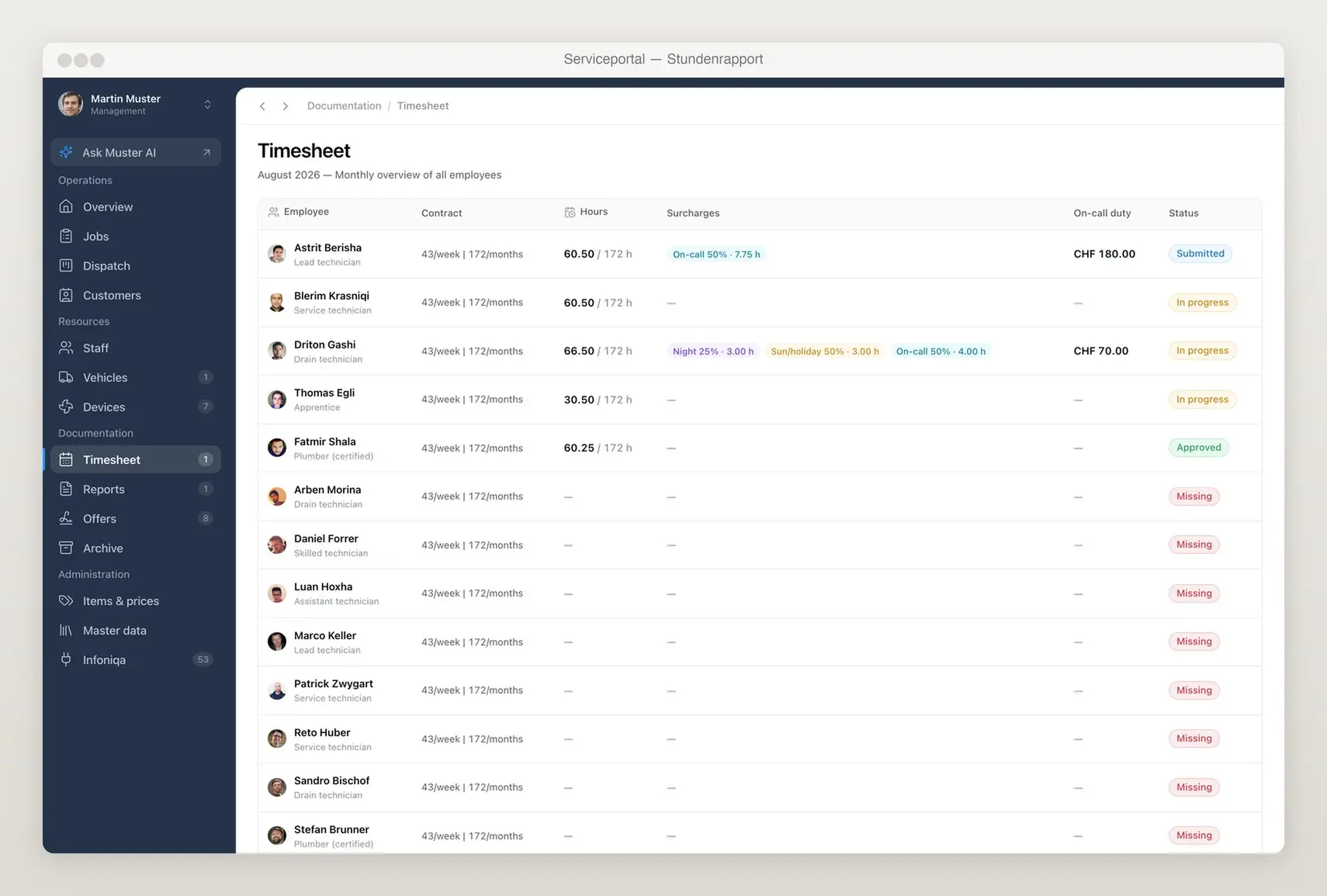
Breaks, night, Sunday and standby premiums come from the times entered, with an approval state per employee.
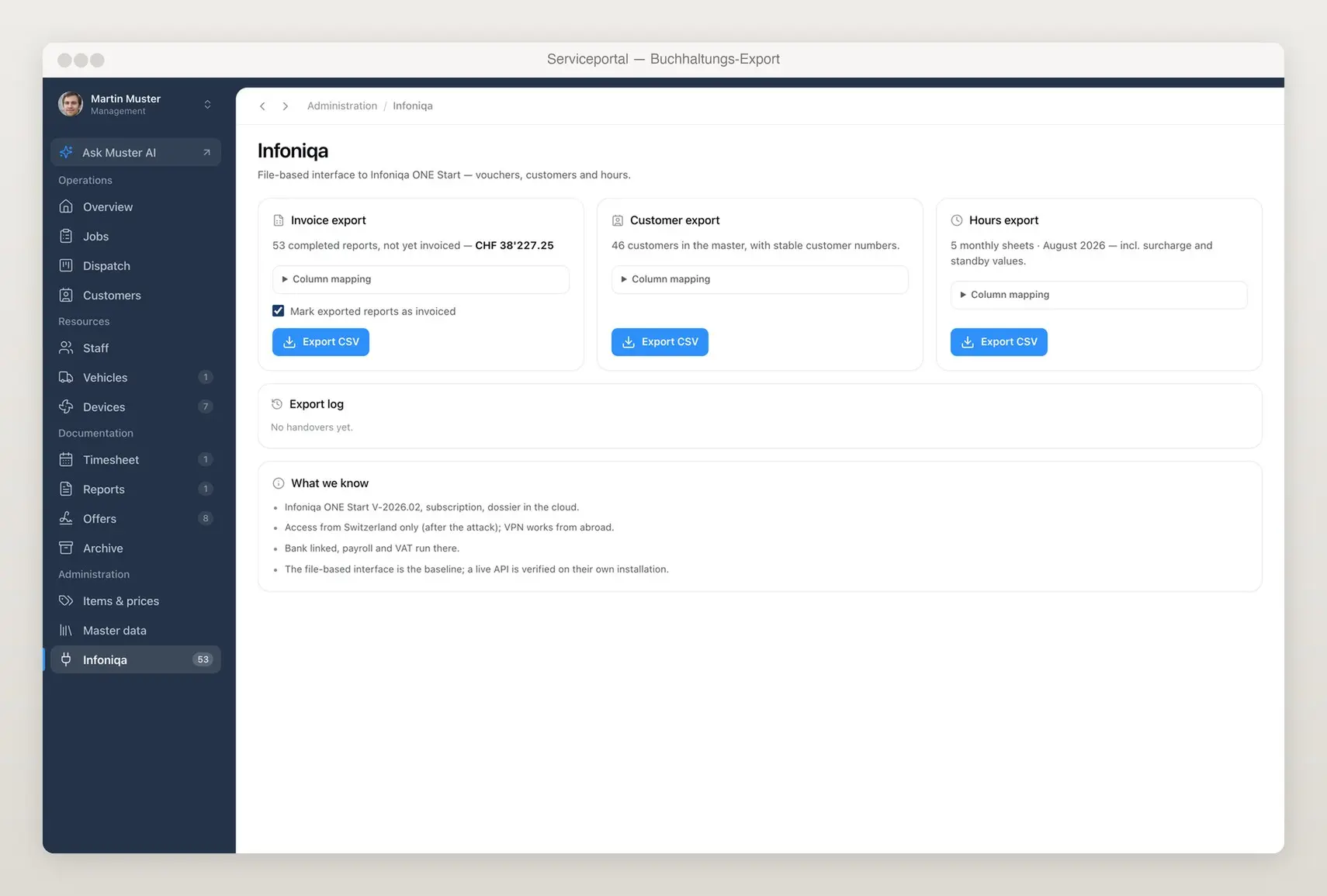
Invoices, customers and hours leave the system as one file batch for the accounting software.
The interface runs in German, English and Albanian, switchable while you work.
Anything printed, emailed or turned into a PDF comes from the German dictionary regardless. A fitter can run the app in Albanian and dictate in Albanian, and the customer still receives a German document.
Part of the workforce prefers Albanian: the dispatch board over the same data as in German.
The overview as the office sees it, in German.
The platform runs on Next.js, React and TypeScript, with server actions for every change, Postgres in the EU through Drizzle, and Groq for the language models. Every read and write goes through one storage layer, so swapping the database backend is a file, not a rewrite.
Documents come from dedicated A4 print pages, not from screenshots of a screen view.
The language model runs on a US provider, and the quote says so.
Letterhead, the six branches, line items and totals on an A4 page.
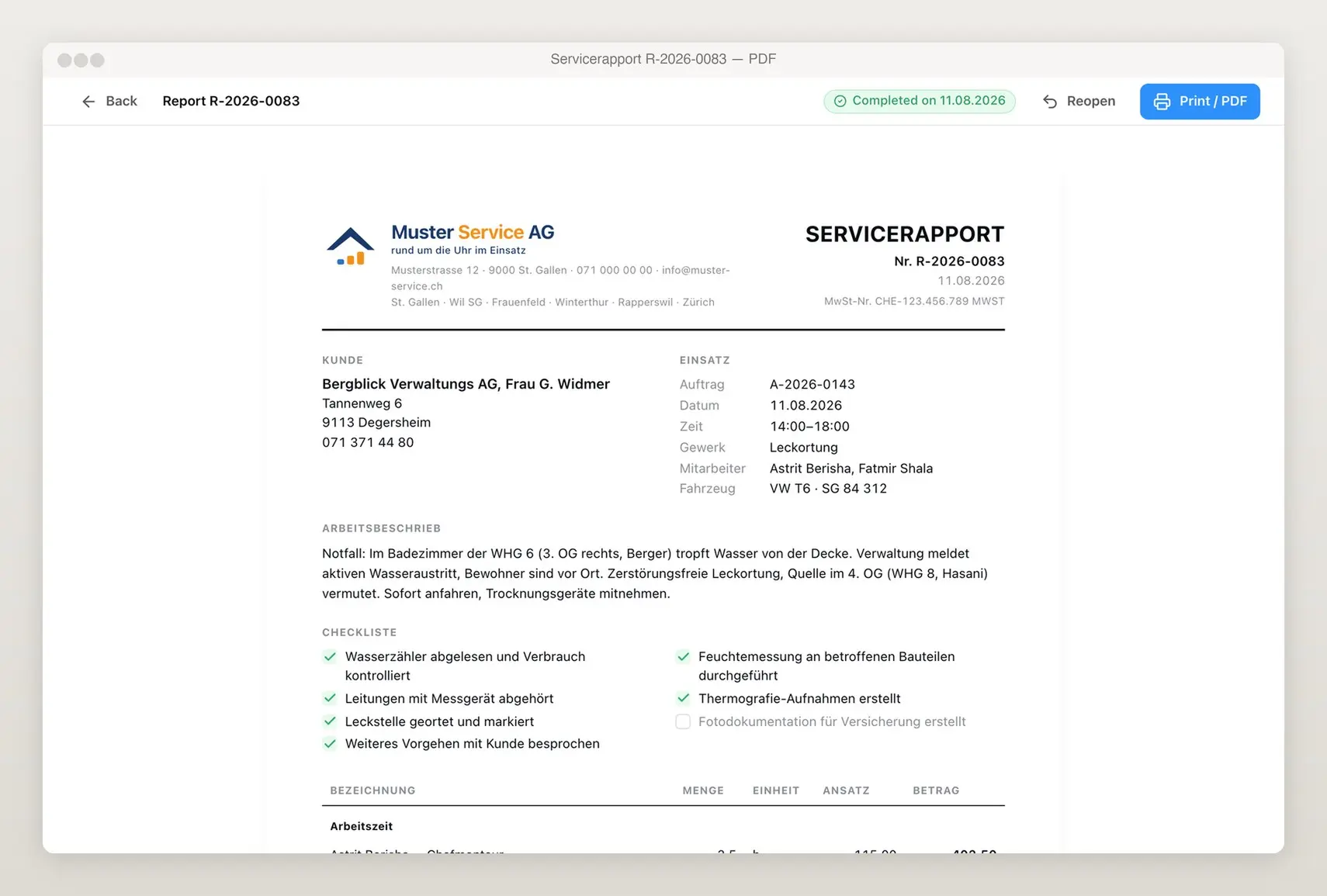
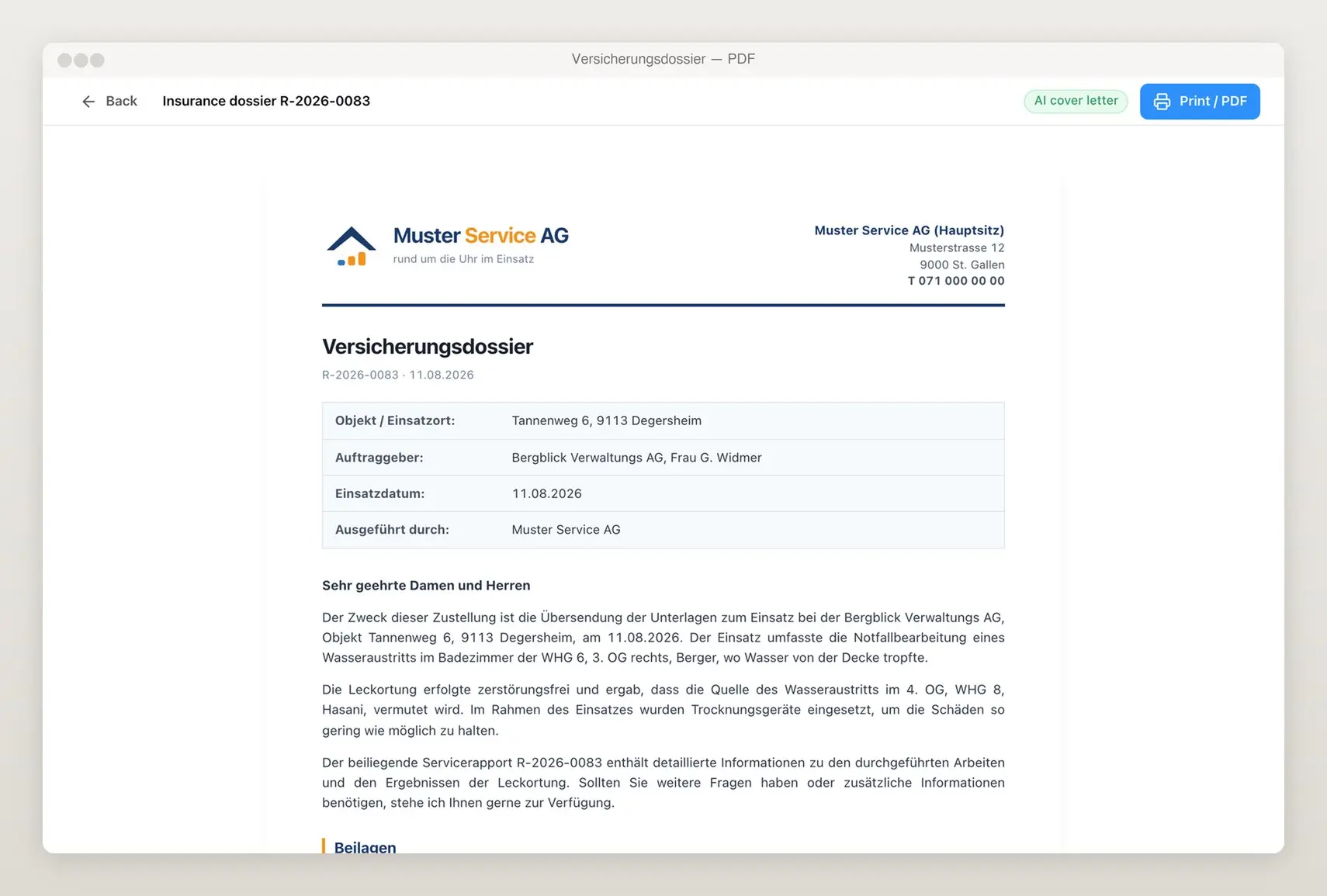
Cover letter, rapport, customer-visible photos and the moisture protocol in one click, including the standing paragraph on handling insurers.
Pluton Studio works from Prishtina, in the same time zone as Switzerland and with European working practice.
What matters is not the location but whether someone is willing to read the fourteen PDF templates properly.
We work regularly with clients in Switzerland, Germany and Austria, in English, and in Albanian with Albanian-owned businesses. What their staff and customers read can still be German, like every document on this platform. How we work with clients abroad is explained under nearshore software development from Kosovo.
If you need something comparable, get in touch.
The price depends on scope: how many modules, how many document templates, which integrations. After a look at your workflow and your forms, you get a free written quote with one total within 2 days.
Roughly four months to full production use, with the vehicle module live considerably earlier. A single module reaches a first working version within 4 to 6 weeks. Work starts from a signed specification.
Yes. The application is not tied to one provider, so Swiss or European hosting both work. A Swiss or European inference path for the language model can be priced separately.
Yes, through a file export in the accounting system's own import format: invoices, customers and hours as a batch, frozen and re-downloadable. A live connection is verified against your installation and quoted separately.
Partly. It expects a connection, but in a basement with no signal the workflow still completes: drafts survive, and every AI feature has a deterministic fallback, badged as a sample.
Yes. Albanian is one of the three interface languages, next to German and English.
No. For line items the model is handed the catalogue and may only choose from it: the label, unit and price come from the database. The assistant answers from real records and says when something is not in them.
Pluton Studio is a software studio in Prishtina, Kosovo, founded in 2018 by software engineer Adrian Fusha. We design and build websites, online stores, web apps, mobile apps, custom business software, AI chatbots, AI agents and process automation for businesses in Kosovo, Albania, the Albanian diaspora and across Europe. You work directly with the engineer who builds your project. The platform was delivered in 2026.
Tell us about your business in a few lines. Adrian Fusha, our founder, replies within one working day, and the fixed quote follows within two working days of the first call. WhatsApp is usually faster.