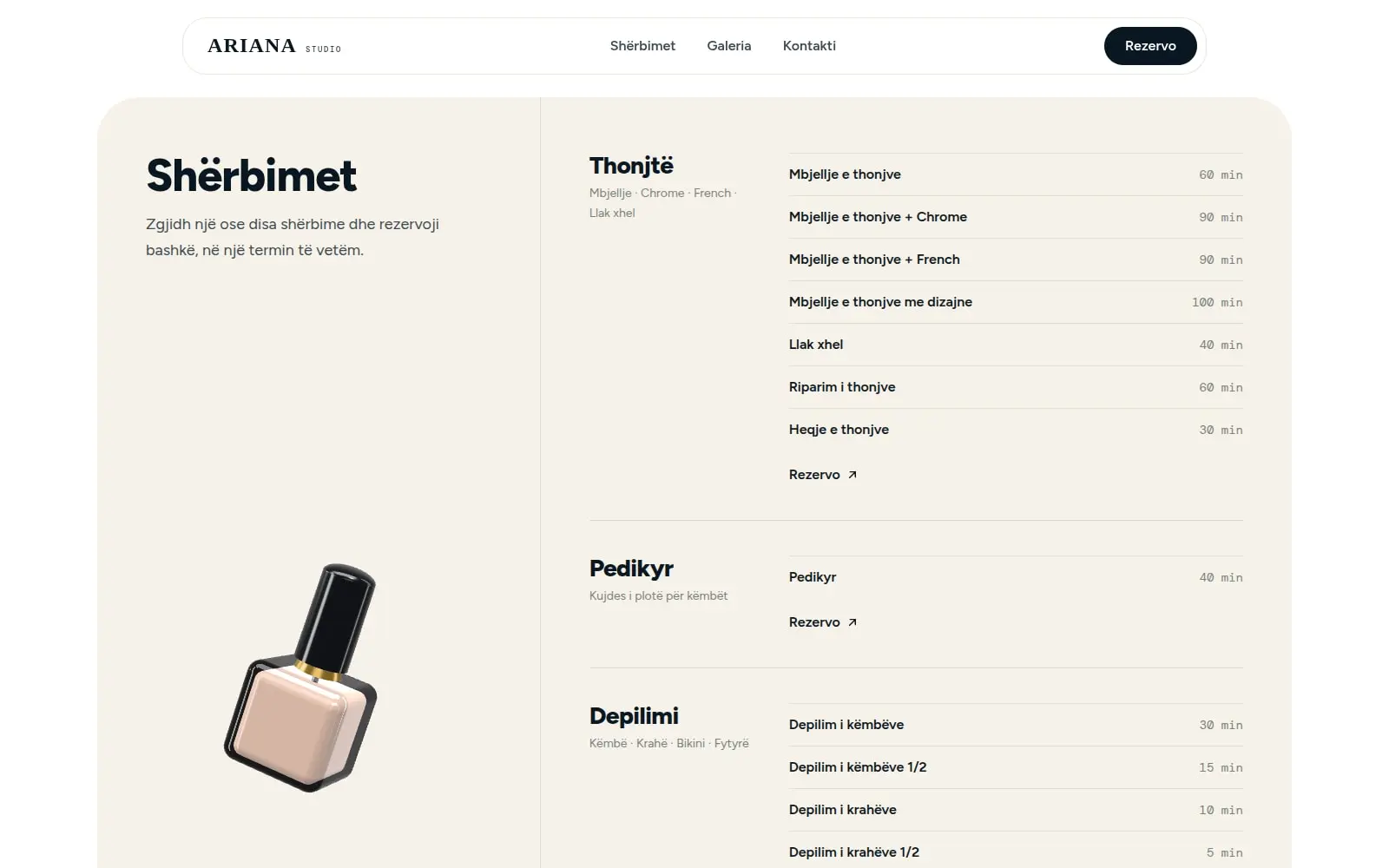
The menu with durations
Every service with its duration, grouped into nails, pedicure and waxing.
Pluton Studio built the website, online booking and owner panel for Ariana Studio, a nails, pedicure and waxing studio in Prishtina. The owner does every appointment herself, so clients book without calling and pick only free times. She runs the day from her phone.
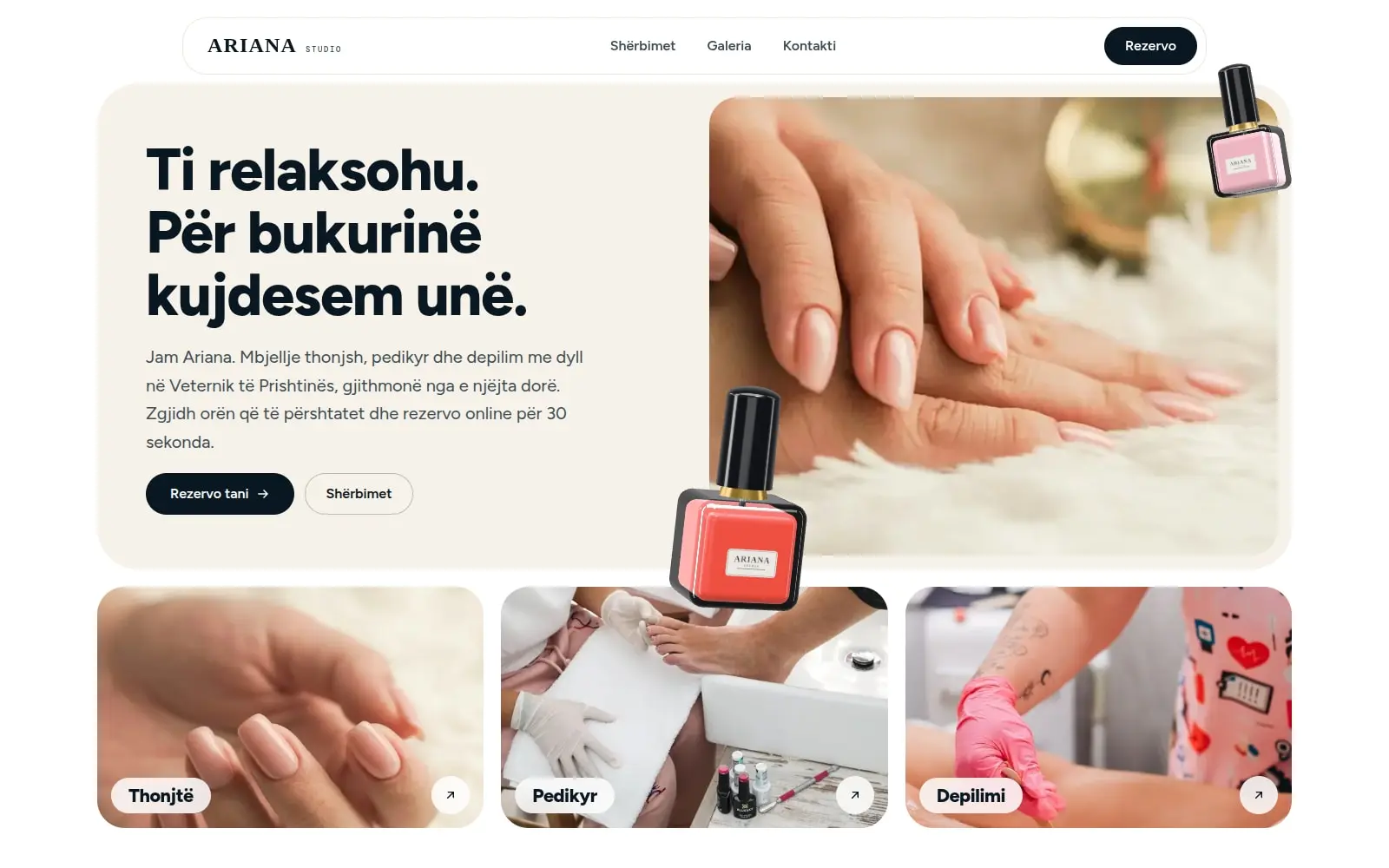
In short
On the Ariana Studio site, a client picks one or more services and books in three steps, in Albanian or English. The owner's panel holds the calendar, clients, menu and opening hours, and sends her a push notification for every online booking or client cancellation. Built with Next.js, Postgres and web push in August and September 2026.
The site had two jobs: present the studio and its menu of gel nails, pedicure and waxing, and take bookings on its own.
Behind it, the owner needed one place to run the day: who is next, what the week looks like, which hours are closed, and a signal on her phone the moment a booking comes in.
Every service with its duration, grouped into nails, pedicure and waxing.
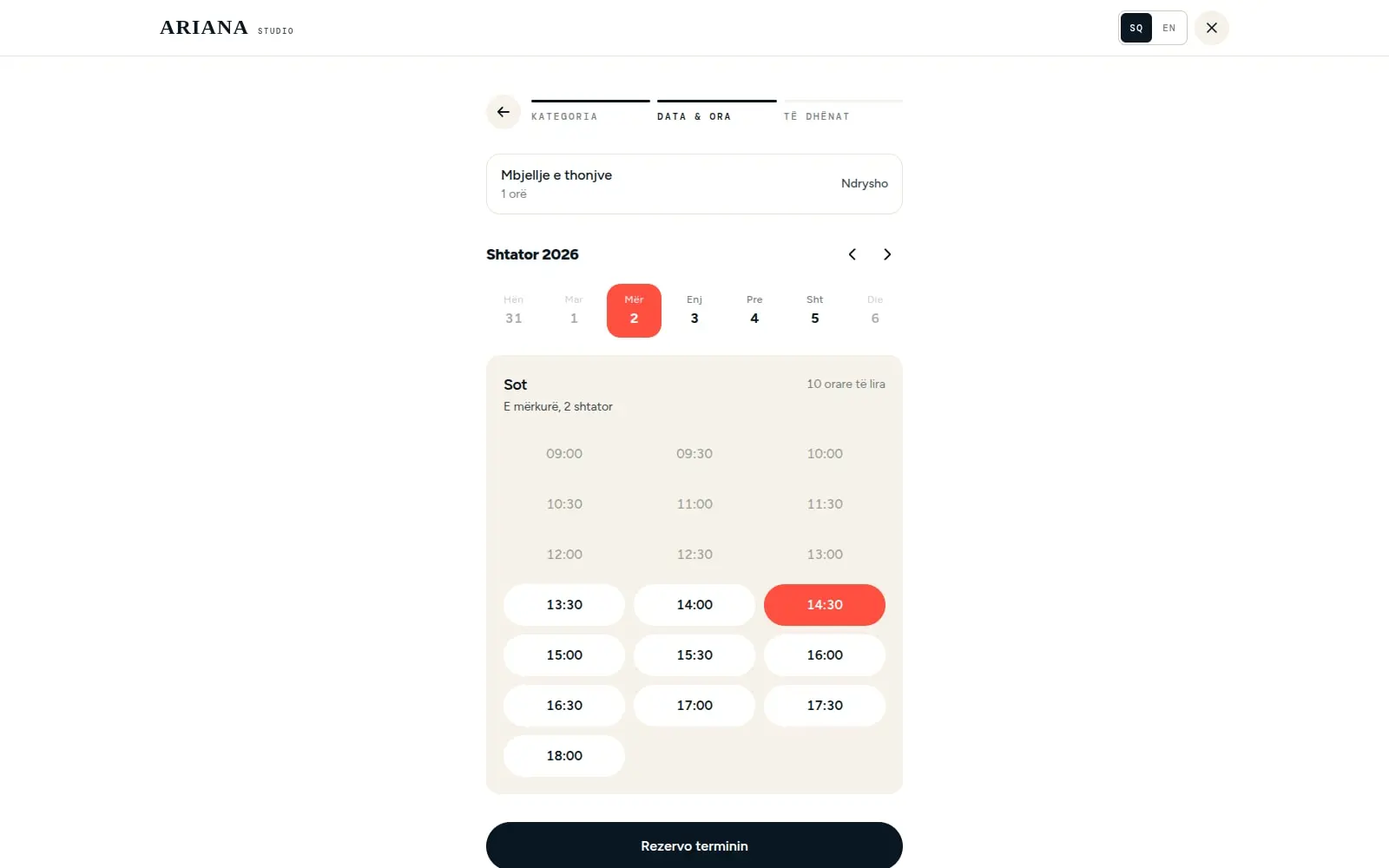
A booking takes three steps: the services, the day and time, and the client's details. When a client picks several services, a gel set and a pedicure for example, the total time shows straight away.
Only real free times are offered. Each one is worked out from the studio's weekly hours, the times the owner has closed, the appointments already booked, the length of the chosen services and the cleanup time she sets after each one.
The menu knows its own rules. A full-body wax already covers the legs, so the two are never booked together. Gel extensions, gel polish and a repair are alternatives, one per appointment, while removal goes with any of them.
The week along the top, the free times for the chosen services below, and the taken times faded.
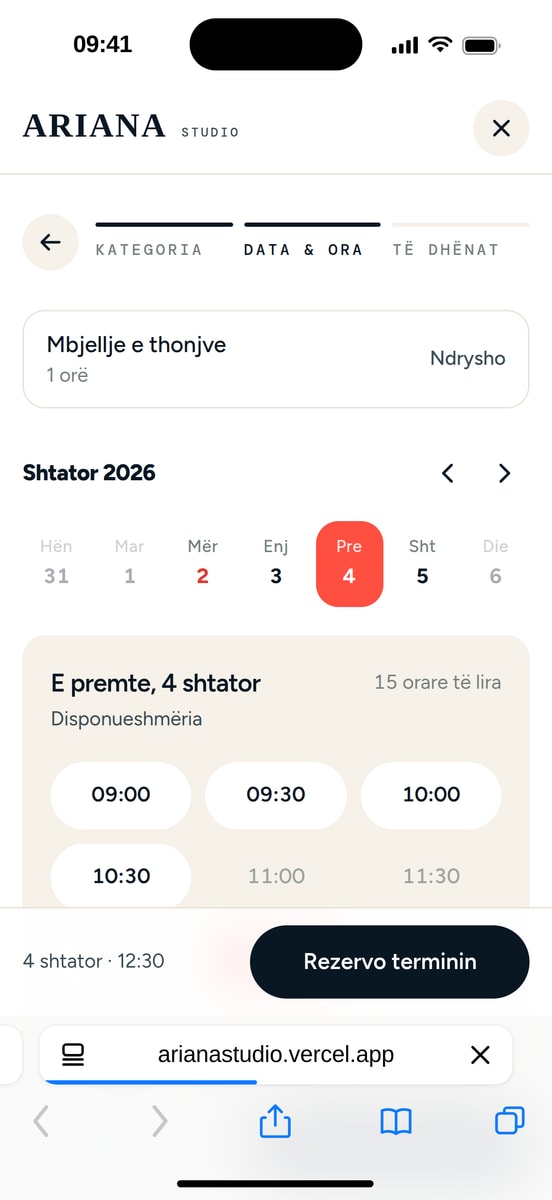
The booking, the confirmation and the owner's panel are all laid out for a phone first.
After booking, the client lands on a page that holds the appointment: the booking code, the service and the time. From there they can add it to their calendar, send the studio a WhatsApp message that is already written, or cancel online until the deadline the owner sets. A client who loses the link finds the appointment again with the code and their phone number.
The phone also remembers the client's name and number for the next booking, and a returning client is welcomed back with their number of visits.
The panel opens on today: the next client, who is in the studio right now and the day's agenda. From there the owner has the calendar by day, week or month, the bookings with search and filters, and a card for every client with their visits, upcoming appointments and her private notes.
On her phone she presses and holds an appointment to move it to another time or day; on a computer she drags it. Walk-ins and bookings taken by phone go in as a new appointment, and that time closes for online booking at once. The panel works in Albanian and English.
An analysis page adds up the completed appointments for a day, a week, a month or any range of dates, next to the value of the appointments still ahead.
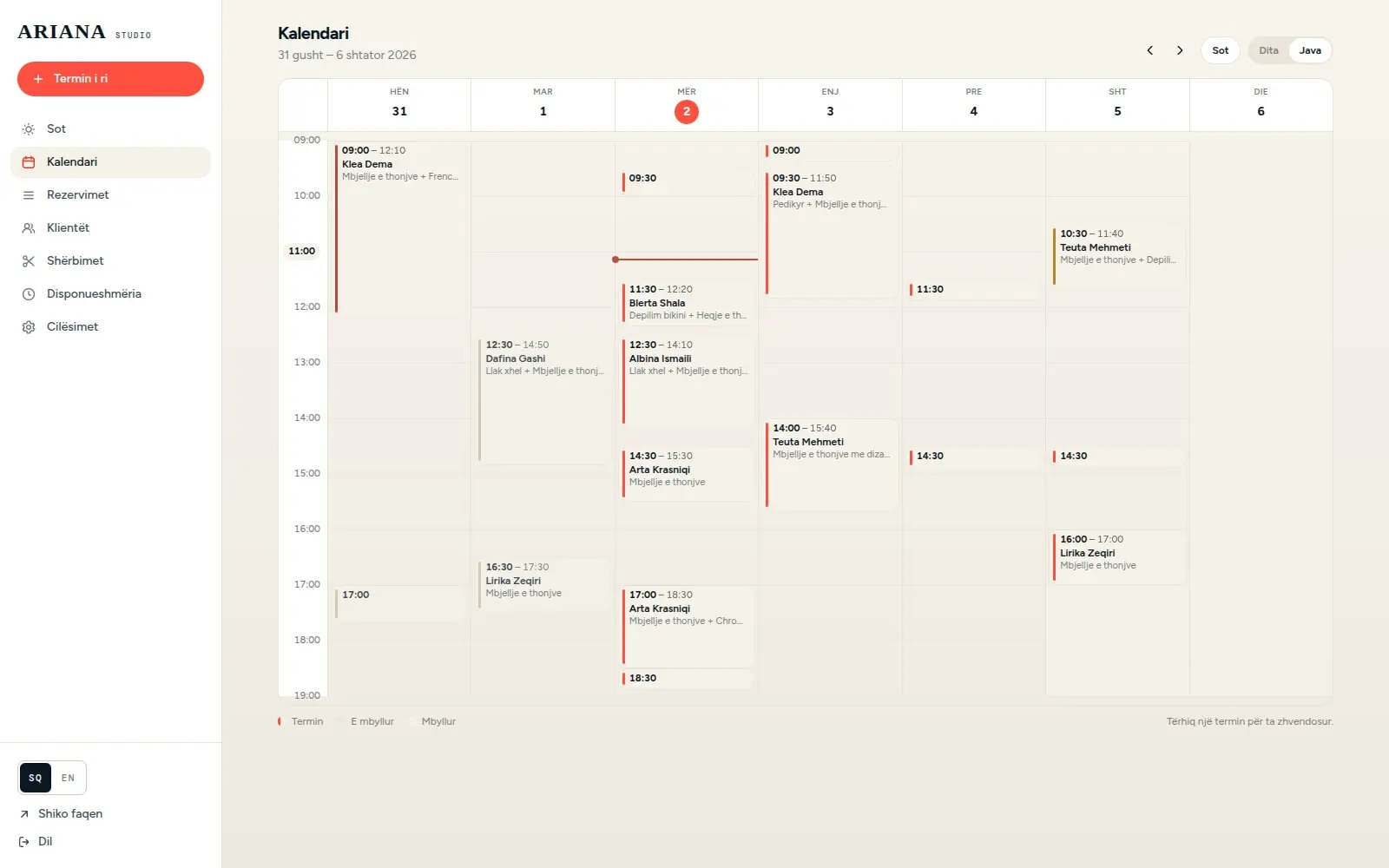
Every appointment of the week with its time and services, shown with demo data.
The panel installs on the phone's home screen like an app. Once the owner turns notifications on, every new online booking and every cancellation by a client reaches her iPhone, Android phone or laptop as a push notification, and a test button shows her what one looks like.
Appointments she adds herself stay quiet. If she prefers to approve each booking, online bookings wait as pending until she confirms them, and the client's page updates as soon as she does.
Everything a client sees about services and times comes from the panel:
The site and the panel run on Next.js 16 and React 19 in TypeScript, with Tailwind CSS, Postgres through Drizzle, and web push for the notifications. The server runs in the EU next to its database, the menu is cached and refreshed the moment the owner edits it, and panel pages show their layout at once while the data loads.
Every page has its own title and description in both languages. The homepage carries the studio's structured data for search engines: address, opening hours, phone and the service menu, built from the same settings the owner edits, so it stays up to date.
The nail-polish bottles are real 3D models drawn with three.js. They turn as the page scrolls, draw only while they are on screen, and stay still for anyone whose device asks for less motion.
Yes, a client can combine several services in one appointment. The calendar then offers only times long enough for all of them.
Through a push notification on her phone or laptop, sent the moment a client books or cancels online.
Yes. She edits prices, hours, closed days and booking rules in the panel, and the site shows each change straight away.
No. Payment happens at the studio, so the booking asks for no card: only a name and a phone number, with an email and a note if the client wants.
Yes, for any business that sells its time by the appointment. The menu, the rules and the hours change; a calendar that offers only real free times stays. Booking systems are one of the business platforms we build.
Pluton Studio is a software studio in Prishtina, Kosovo, founded in 2018 by software engineer Adrian Fusha. We design and build websites, online stores, web apps, mobile apps, custom business software, AI chatbots, AI agents and process automation for businesses in Kosovo, Albania, the Albanian diaspora and across Europe. You work directly with the engineer who builds your project. The Ariana Studio site, booking system and panel were built in August and September 2026.
Tell us about your business in a few lines. Adrian Fusha, our founder, replies within one working day, and the fixed quote follows within two working days of the first call. WhatsApp is usually faster.