How much does an online store cost in Kosovo?
The cost of an online store in Kosovo comes down to seven decisions: how many products you sell, how customers pay, what the store connects to, the design, the content, the languages and what gets maintained after launch. This guide explains them one by one, so you know what to ask for in a quote.
By Adrian Fusha, Pluton Studio
On this page
The seven decisions that move the cost
Two stores that both sell online can be worlds apart in effort: one with ten products and cash on delivery, another with thousands of products, card payments, a courier integration and two languages. So there is no figure that fits everyone: the quote is built around your store.
The table below sums up all seven decisions. As soon as you tell us what you need in each row, we turn it into a fixed written quote.
| Decision | Simpler to build | More involved | Why it moves your quote |
|---|---|---|---|
| Number of products | Small, fixed catalog | Large catalog with variants | Data entry, filtering, performance |
| Payments | One method, e.g. cash on delivery | Card gateway plus several methods | Bank onboarding, integration, testing |
| Integrations | None, standalone | Courier, POS and accounting | Each connector is work of its own |
| Design | Refined template | Experience built for the brand | Design and build hours |
| Content | You supply text and photos | We write and photograph | Content production effort |
| Languages | Single language | Multi-language and several markets | Translation and checkout logic |
| Ongoing | Minimal upkeep | Active catalog plus support plan | Recurring maintenance |
How many products you sell (catalog size)
The number of products moves the cost more than any other factor. It changes the data entry, but also how categories are organised, how products are filtered and how fast the page loads when the list is long.
Variants raise the effort further. A shirt in three sizes and four colours is not one product but twelve combinations, each with its own stock, price and photos. If the data arrives ready in a file for import, the work moves faster than entering it one item at a time.
- Small fixed catalog vs. a large catalog that keeps growing
- Variants (size, colour) multiply products, stock and photos
- Categories, filters and search that keep the store easy to use
- Bulk import vs. manual entry of products
How customers pay: cash on delivery, transfer or card
Each payment method means work and testing. The simplest is cash on delivery or bank transfer. Card payments add a gateway from a Kosovo bank and more careful testing before going live.
In Kosovo, cards run through bank gateways such as Raiffeisen, TEB or ProCredit, with 3-D Secure. The agreement with the bank is in your name, while we take the technical side of the integration.
For buyers in the Albanian diaspora in Germany, Switzerland or Austria, card payment is a baseline expectation. More in online payments in Kosovo.
What does the store need to connect to?
Every system the store connects to is work in its own right, and this is where most of the difference between two similar-looking quotes hides. A standalone store is built quickly; a store that notifies the courier, updates stock in the POS and sends data to accounting is several small projects together.
The real question is whether a connector already exists or has to be built. When a standard connector exists, the integration is fast. When your system needs one built from scratch, that is engineering work: see custom software development.
- Courier or postal service for delivery and order tracking
- Stock, POS or warehouse that has to stay in sync
- Accounting and fiscal invoices
- Email and WhatsApp notifications for the customer and your staff
- CRM, marketing and analytics to measure sales
Design and content
Design sits between a refined template and an experience built from scratch around the brand. The second takes more hours, but gives you a store that does not look like thousands of others and that guides the buyer to checkout. A store that is fast and clear on a phone sells more from the same traffic; for the visual side, see web design in Kosovo.
Content is the most underestimated line item and the most common cause of delay. If you supply the descriptions and photos ready, the work moves fast; if we produce them, that is real work for every product. Migrating an existing catalog means cleaning, mapping and verifying the data.
Languages and markets
If you sell only inside Kosovo in Albanian, one language is enough. As soon as you add English or target markets abroad, the store becomes multi-language: the interface, the product descriptions and the checkout.
Multiple markets add logic: currency, shipping and tax rules per country, and often different content for each market. For businesses selling to the Albanian diaspora, that is real work to be quoted. More on the online store page.
Operating the store after launch
An online store needs clear responsibility for hosting, security, backups and support after launch.
The quote defines these responsibilities based on the size and activity of the store. A small catalogue has different needs from a store with hundreds of orders a day.
- Hosting and domain that keep the store online
- Handling of payments and transactions through the bank
- Security updates and backups
- Support when something needs fixing or adding
- Content and catalog updates
How to compare quotes for a store
Two quotes with different totals often do not describe the same store. Before you compare them, check that each one answers these questions:
- Is card payment included, along with getting the site ready for the bank's approval?
- Who loads the products, variants and photos, and how many of them?
- Which integrations are in: courier, POS, accounting?
- Is the design made for your brand or a template?
- What is covered after launch, and for how long?
- Do the domain, the customer data and the right to export them stay in your name?
- Red flag: a single total with no itemised lines, or a mandatory subscription that only shows up later.
Get a fixed quote for your store
The quote is set by your scope. Tell us your catalog (how many products and whether they have variants), how customers will pay, what systems it connects to and which markets you sell in. Within two days of the first call you get a free, fixed written quote.
If you are choosing between a subscription platform and a store built for you, read the online store platform guide. Compare the features, the integrations, who owns the data and whether you can export it.
If you are still deciding between a site and a store, see how much a website costs and, for the process from the start, how to build a website.
Selected work
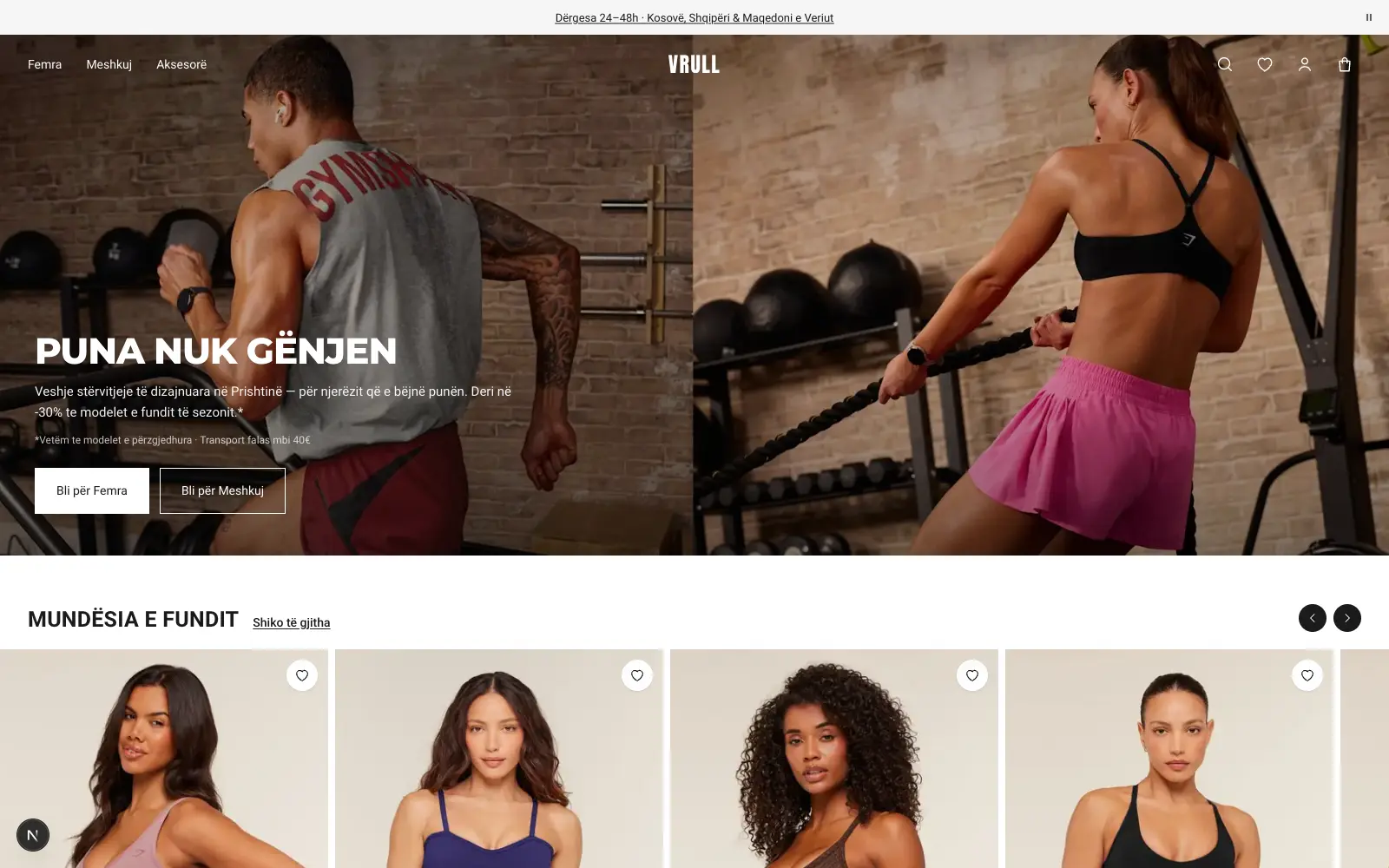 Own brand / Activewear · 2026
Vrull Store
Our own activewear label and its online store: seamless kit, a hard-working brand voice in Albanian and cash-on-delivery-first checkout.Visit site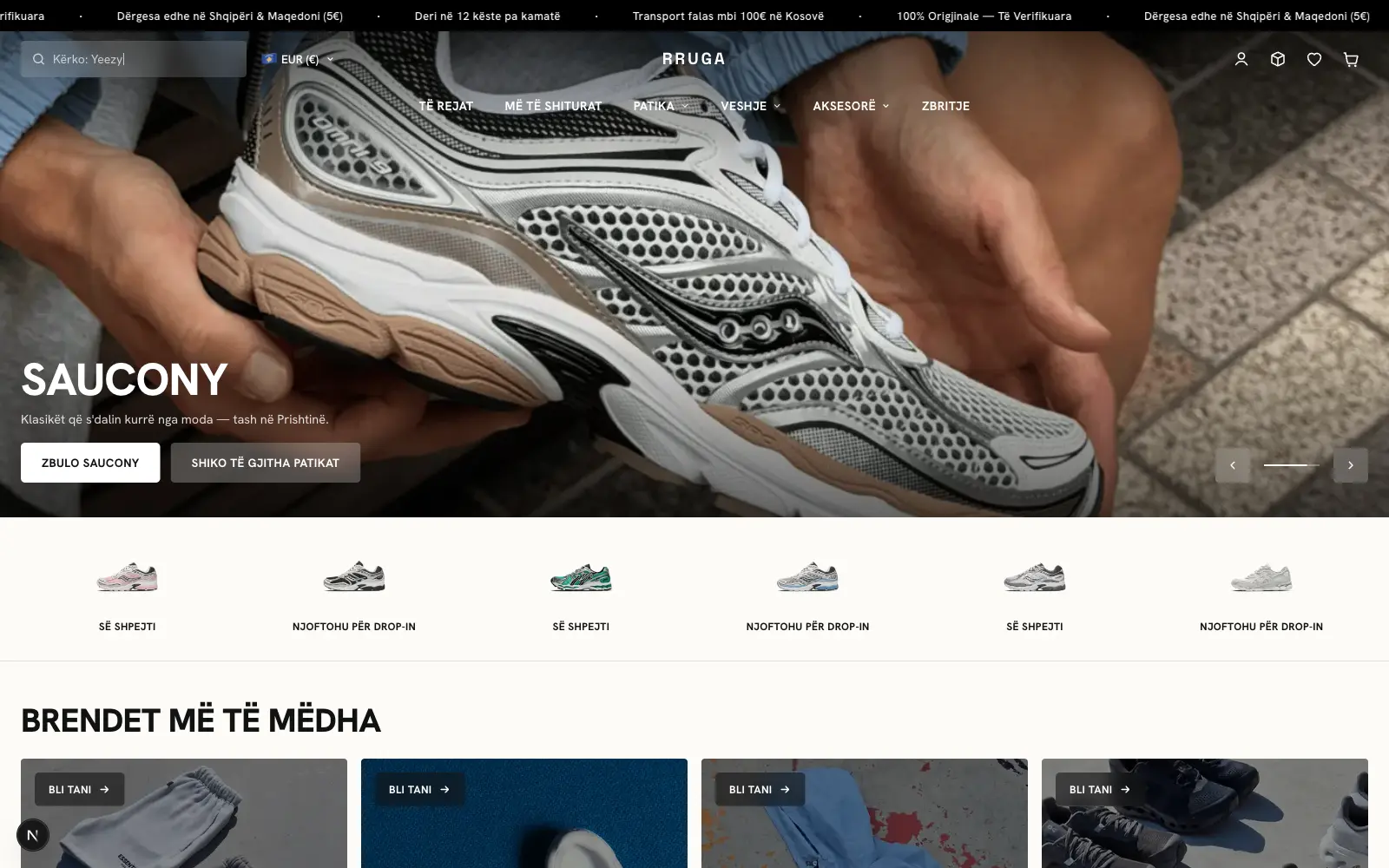 Own brand / Sneakers · 2026
Rruga Shoe Store
Our own sneaker-resale store with 159 pairs: EU sizing, instalment-friendly pricing and authenticity-first trust, in Albanian.Visit site Own brand / Press-on nails · 2026
Kthetra
Our own press-on-nails brand and its store: salon quality in minutes, reusable and vegan, with playful Albanian copy end to end.Visit siteFrequently asked questions
How much does an online store cost in Kosovo?
The cost is moved by seven decisions: products, payments, integrations, design, content, languages and maintenance. At Pluton Studio a store takes 5 to 8 weeks to build, and you get the fixed written quote free of charge within two days of the first call.
What is the cheapest way to start selling online in Kosovo?
Start small: a lean catalog and one payment method such as cash on delivery, then grow the store as sales come in. But start on a base that grows, because what is saved at the start often gets rebuilt later.
Can I accept card payments in my online store?
Yes, through Kosovo bank gateways such as Raiffeisen or ProCredit. The agreement with the bank is in your name, while we take the technical integration and testing.
Does the number of products really change the cost that much?
Yes, a lot. Catalog size affects data entry, categories, filtering and performance, while variants multiply the work. Maintenance also grows when the catalog is large and active.
What does online store maintenance cover?
Hosting, security updates, backups, monitoring and support, as defined in the quote for your store. Domain, email and payment services are specified separately.
Can the store sell to the diaspora and abroad?
Yes. It needs multi-language, currency and per-market shipping and tax rules, plus translated products and checkout. That is work we add to the quote.
How long does it take to build an online store?
With us usually 5 to 8 weeks, depending on the catalog, how ready the content is and the integrations. The most common bottleneck is not the build but waiting for product text and photos.